Orthostatic Hypotension

Introduction

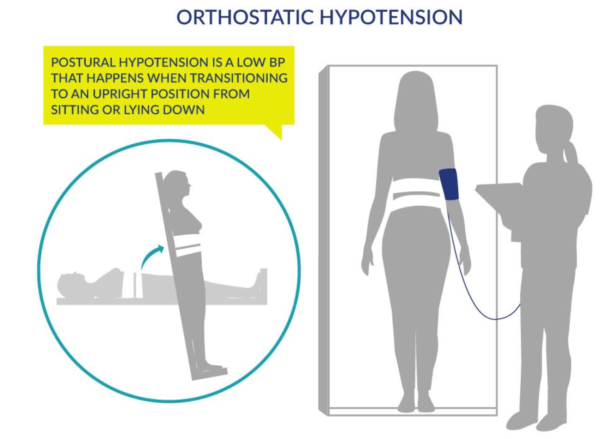
The Consensus Committee of the American Autonomic Society and the American Academy of Neurology (CCAAS&AAN 1996) defined orthostatic hypotension (OH) as a decrease in systolic blood pressure of at least 20mmHg, or a reduction in diastolic blood pressure of at least 10mmHg, upon the change in body position from a supine position to an upright posture, regardless of the presence of symptoms. Several studies have documented the presence of OH following SCI (Chelvarajah, 2009, Cariga et al. 2002, Faghri et al. 2001; Mathias 1995).  This condition occurs during the acute period of injury and persists in a significant number of individuals for many years (Claydon et al. 2006; Frisbie & Steele 1997).  Standard mobilization treatment during physiotherapy (e.g., sitting or standing) is reported to trigger blood pressure decreases that are diagnostic of orthostatic hypotension in 74% of SCI patients, and cause symptoms of orthostatic hypotension (such as lightheadedness or dizziness) in 59% of SCI individuals (Illman et al. 2000).  Thus, this may discourage SCI individuals from participating in rehabilitation. Management of OH consists of pharmacological and non-pharmacological interventions.
The low level of efferent sympathetic nervous activity and the loss of the reflex vasoconstriction following SCI are the two major causes of OH (Table 1).  The decrease in blood pressure following the change to an upright position in individuals with SCI may be related to excessive pooling of blood in the abdominal viscera and lower extremities (Krassioukov & Claydon, 2006; Claydon et al. 2006; Mathias 1995). This decrease is compounded by the loss of lower extremity muscle function post-SCI that is known to be important in counteracting venous pooling in the upright position. Excessive venous pooling in the lower extremities coupled with reduced blood volume in the intrathoracic veins lead to a decrease in ventricular end-diastolic filling pressure and end-diastolic volume thereby decreasing left ventricular stroke volume (Ten Harkel et al. 1994).  The reduced ventricular filling and emptying ultimately lead to a reduction in cardiac output, and thus, arterial pressure (provided the reductions in cardiac output are marked). Unloading of the arterial baroreceptors induces a reflexic reduction in cardiac parasympathetic (vagal) activity. As a result, tachycardia may occur, although this is usually insufficient to compensate for decreased stroke volume.  A reduction in cardiac output results and in turn, arterial blood pressure is reduced. Subsequently, pooling of blood in the lower extremities and decreased blood pressure results in reduced cerebral flow, which presents as a number of signs and symptoms (Table 2).

In addition to central causes of OH following SCI, there is also some evidence suggesting peripheral contributions. For example, upregulation of the potent vasodilator nitric oxide (NO) could potentially contribute to the orthostatic intolerance in this population (Vaziri 2003). In animal studies, it has been shown that NO synthase expression is dysregulated following SCI (Zhao et al. 2007).  Moreover, Wecht and co-investigators found that intravenous infusion of NO synthase inhibitors facilitated normalization of blood pressure in individuals with SCI (Wecht et al. 2007).

Several other factors may predispose individuals with SCI to OH, including low plasma volume, hyponatremia, and cardiovascular deconditioning due to prolonged bed-rest (Claydon et al. 2006; Illman et al. 2000; Mathias 1995).  The prevalence of OH is greater in patients with higher spinal cord lesions, and thus it is more common in tetraplegia (Claydon et al. 2006; Mathias 2006; Frisbie & Steele 1997).  Furthermore, individuals with cervical SCI also experience greater posture-related decreases in blood pressure than those with paraplegia ( Claydon et al. 2006; Mathias 1995).  There is also an increased risk of OH in individuals who sustain a traumatic SCI than in nontraumatic injury such as spinal stenosis (McKinley et al. 1999).

Table 1: Factors Predisposing to OH following SCI

Multifactorial   Claydon et al. 2006
Loss of tonic sympathetic control  Houtman et al. 2000; Wallin & Stjernberg 1984
Altered baroreceptor sensitivity Wecht et al. 2003; Munakata et al. 1997;
Lack of skeletal muscle pumps Faghri & Yount 2002; Raymond et al. 2002
Ten Harkel et al. 1994
Cardiovascular deconditioning  Hopman et al. 2002; Vaziri 2003
Altered salt and water balance Frisbie 2004

Table 2: Signs and Symptoms of OH

  • Light-headedness
  • Dizziness
  • Fainting
  • Blurred vision
  • Fatigue
  • Muscle weakness
  • Syncope (temporary loss of consciousness)

Krassioukov A, Warburton DER, Teasell RW, Eng JJ (2010). Orthostatic Hypotension Following Spinal Cord Injury. In: Eng JJ, Teasell RW, Miller WC, Wolfe DL, Townson AF, Hsieh JTC, Connolly SJ, Mehta S, Sakakibara BM, editors. Spinal Cord Injury Rehabilitation Evidence. Version 3.0. Vancouver: p 1-20.